
Intended Impact, Theory of Action, Theory of Change, and Ultimate Vision
A. Introduction
The nonprofit space does not lack jargon (I blame consultants). The absence of a common language can be a major obstacle to making decisions and executing them. The following concepts – Intended Impact, Theory of Action, Theory of Change, and Ultimate Vision – when used as a common language, are what lets a team make a decision and explain it. Organizations may also use related concepts such as a strategic hypothesis or logic model to articulate and agree on strategy. As always, what’s most essential is that everyone involved in making a decision uses the same terminology with the same definitions.
The Fantastic Four of Articulating a Strategy
Accountable
Aspirational
Intended Impact (II)
- Who an organization is seeking to serve and Where they are.
- What major outcomes an organization will help them achieve, and When – over what timeframe.
- Cost per beneficiary served and per outcome achieved.
Ultimate Vision (UV)
- What is the ultimate population that would benefit if this strategy was implemented at scale?
- What long-term value is created for this population? What is the aspirational timeline?
Theory of Action (ToA)
- Articulates the How – the specific actions an organization will take to achieve its Intended Impact.
- Can be laid out as a series of if-then steps so that the relationships among the actions and programs can be understood.
Theory of Change (ToC)
- Articulates the systems-level change in conditions that an organization aspires to achieve and that a successful II/ToA contributes to.
- Includes the actions that other stakeholders must take to achieve systems-level impact.
What an organization holds itself accountable for achieving and expects others to hold it accountable for.
Broader systems-level impact that an organization contributes to, and can even measure, but does not hold itself directly accountable for achieving (unless it is explicitly pursuing a Systemic Impact strategy).
Intended Impact (II)
- Who an organization is seeking to serve and Where they are.
- What major outcomes an organization will help them achieve, and When – over what timeframe.
- Cost per beneficiary served and per outcome achieved.
Ultimate Vision (UV)
- What is the ultimate population that would benefit if this strategy was implemented at scale?
- What long-term value is created for this population? What is the aspirational timeline?
Theory of Action (ToA)
- Articulates the How – the specific actions an organization will take to achieve its Intended Impact.
- Can be laid out as a series of if-then steps so that the relationships among the actions and programs can be understood.
Theory of Change (ToC)
- Articulates the systems-level change in conditions that an organization aspires to achieve and that a successful II/ToA contributes to.
- Includes the actions that other stakeholders must take to achieve systems-level impact.
Intended Impact creates a Theory of Action and contributes to the Ultimate Vision. Ultimate Vision creates a Theory of Change, which the Theory of Action contributes to.
Articulating both a Theory of Action and Theory of Change can create clarity.
Some organizations use these terms interchangeably. Some organizations use one term, but with both meanings. Both approaches create confusion.
However, articulating both enables an organization to distinguish between outcomes driven directly by the organization’s actions and those dependent on a broader set of changes to a system that the organization contributes to but is not on the hook for achieving.
If an organization is going to use just one concept in its strategy, I recommend using Theory of Action to specifically explain what it is doing to create its Intended Impact and what it is attracting resources for.
B. Intended Impact
Intended Impact statements have four components that are usually grouped as Who and Where, and then What and When.
(1) Who are the target beneficiaries, and
(2) Where are they?
Attributes
- By demographics (race/ethnicity, gender).
- By family income.
- By age.
- By first-generation status, immigrant status, undocumented status, experience with the justice system, etc.
- By education status, level of education, or other life achievement.
Locations
- Different geographies.
- Different types: urban, suburban, and/or rural.
- Different resources (like per-pupil funding), laws, practices, or cultures that influence what an organization can and must do in its Theory of Action.
Different Needs
For example, by status within K-12 education…
- Pathway 1: Significant barriers to achieving progress, acute need
- Pathway 2: Out of school, no diploma
- Pathway 3: In high school, more than two grades behind
- Pathway 4: Out of high school with a diploma but no employment or college pathway
- Pathway 5: In high school, on track (two or fewer grades behind)
…or by different stages of their education journey.
to, acceptance by,
and selecting a college
(3) What outcomes are being achieved, and
(4) When (e.g., over what timeframe)?
Some organizations have a simple definition of their target beneficiaries and a narrow set of outcomes that they want to measure and hold themselves accountable for achieving.
However, most organizations have a complex set of outcomes they measure and hold themselves accountable for because they:
- Serve a large and diverse set of beneficiaries.
- Provide complex, multi-part programming.
- Work with beneficiaries over a long period as they transition from one age or stage of achievement to another (which is why the When of a timeframe is logical to combine with the What of outcomes).
- Need to measure a range of outcome types to assess progress and understand where obstacles arise.
- Are pursuing a combination of Direct, Widespread, and/or Systemic Impact.
(5) The Cost?
Increasingly, organizations and their funders are setting specific measures of performance around the cost of serving a beneficiary and/or a cost per outcome. Organizations are looking at how to bring their innovations to scale over the long term, and what long-term and large-scale funding is available to support this. Organizations are considering trade-offs in their focus on breadth versus depth of impact, which is driving potential changes to program designs (such as varying dosage, format, etc.). And of course, there is also the impact of Artificial Intelligence on programs, and what that means for scale, success, and sustainability.
Where does an Intended Impact end and other measurement begin?
Intended Impact is the “top of the pyramid” of beneficiary outputs and outcomes an organization wants to achieve by the end of its strategic plan. But there are many earlier measures an organization will want to manage to because the performance against these measures determines an organization’s ability to achieve its Intended Impact. Please visit the Measurement Page for more details and for examples of laying this out.
What about setting specific Intended Impact targets?
Please also see the Measurement Page for details on target setting. Additionally, target-setting is based on the resources an organization believes will be available (financial, talent, systems, political capital, and partnerships) to fuel its Theory of Action. Constraints on resources become constraints on ambition and therefore targets of performance.
C. Theory of Action
A Theory of Action articulates how an organization will achieve its Intended Impact. A Theory of Action can be articulated as a series of if-then steps so that the relationships among the actions can be understood.
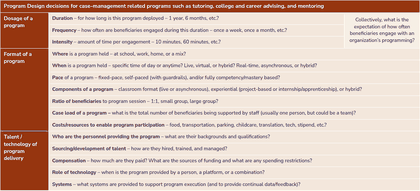
Even a Theory of Action with only a single program still has to consider a complex set of different elements of that program’s design. For example, here are the program design decisions related to case-management programming like tutoring, postsecondary and career advising, and mentoring.
| Program Design decisions for case-management-related programs such as tutoring, college and career advising, and mentoring | ||
|---|---|---|
| Dosage of a program | Duration – for how long is this program deployed – 1 year, 6 months, etc.? | Collectively, what is the expectation of how often beneficiaries engage with an organization’s programming? |
| Frequency – how often are beneficiaries engaged during this duration – once a week, once a month, etc.? | ||
| Intensity – amount of time per engagement – 10 minutes, 60 minutes, etc.? | ||
| Format of a program | Where is a program held – at school, work, home, or a mix? | |
| When is a program held – specific time of day or anytime? Live, virtual, or hybrid? Real-time, asynchronous, or hybrid? | ||
| Pace of a program – fixed-pace, self-paced (with guardrails), and/or fully competency/mastery based? | ||
| Components of a program – classroom format (live or asynchronous), experiential (project-based or internship/apprenticeship), or hybrid? | ||
| Ratio of beneficiaries to program session – 1:1, small group, large group? | ||
| Caseload of a program – what is the total number of beneficiaries being supported by staff (usually one person, but could be a team)? | ||
| Costs/resources to enable program participation – food, transportation, parking, childcare, translation, tech, stipend, etc.? | ||
| Talent/technology of program delivery | Who are the personnel providing the program – what are their backgrounds and qualifications? | |
| Sourcing/development of talent – how are they hired, trained, and managed? | ||
| Compensation – how much are they paid? What are the sources of funding and what are any spending restrictions? | ||
| Role of technology – when is the program provided by a person, a platform, or a combination? | ||
| Systems – what systems are provided to support program execution (and to provide continual data/feedback)? | ||
Most Theories of Action consist of more than one program:
1. Program variations. For example, even a tutoring, advising, or mentoring nonprofit may have multiple program models that vary based on the populations they serve, what their funders or customers want, and/or what different funding levels or state and local policies allow.
2. Multi-stage programs. Some nonprofits may have a multi-stage program because they serve beneficiaries (in this case students) across multiple ages/stages of their journey.
Example of an organization serving students P-16
to, acceptance by,
and selecting a college
3. Some organizations have beneficiaries who pursue different paths. In this example, different student profiles or student choices about postsecondary pathways lead to two paths, each with potential variations in programming as well as potential differences in beneficiary outcomes (such as pathway completion type) even if common long-term outcomes such as employment and earnings are then tracked for both.
Example of an organization serving students P-16
to, acceptance by,
and selecting a pathway
Conventional college pathways
Non-degree postsecondary pathways
4. And then there is a school. Perhaps there is nothing more complicated than running a school. As I have written about previously, starting, scaling, and sustaining the performance of an excellent school is like asking an orchestra to perform the 1812 Overture while also playing full-contact rugby – for at least 180 days of the year, every year – and with musicians/players regularly being replaced.
To be excellent, a school must excel in nearly all of the design elements below simultaneously. And it doesn’t stop there. Not only must a school be excellent in these design elements, but every element must be aligned and integrated with all the others to work well.
The impact of an excellent curriculum can be limited if it doesn’t line up with assessments, teacher professional development, or school operations (as it turns out, it’s challenging to teach a curriculum if buses break down). To quote the wisdom of Lauryn Hill, sometimes, “Everything Is Everything.”
Design Elements of a School: (one way to organize them)
Governance and Leadership
- State Board
- State Department of Education
- District Central Office
- Charter Authorizer (if applicable)
- District Board
- School Board
- School Leadership: Principal, Assistant Principal, Deans, Grade-Level Chairs, etc.
- Stakeholder roles in governance: teachers, parents, students
Unifying Education Vision and School Design
What is taught, how it is taught, how it is supported, how it is assessed, what relationships look like in a school, how time is used by the school, how talent is deployed, and ultimately how a school provides an environment and a set of experiences that successfully prepares all students to achieve economic independence, to fully participate in democracy, and to pursue happiness as they define it.
School Culture and Community
- Classroom management
- Student conduct management
- Use of data for continuous improvement
- Relationships – leaders, staff, students, and parents
Aligned Academic Content
Content
- Standards
- Curriculum
- Unit plans
Formats
- Classroom instruction
- Use of technology and AI
- Experiential and project-based learning
- In-person, remote, or hybrid instruction
- Live, asynchronous, or a combination
Assessment
- Weekly assessments
- Formative assessments
- Summative assessments
School Structure
- Grades served and students per grade
- Students per classroom
- School day/week/year
- Master day schedule (blocks, hours)
Differentiated Instruction
- Individualized learning plans
- Personalized/adaptive learning modes
- Learning recovery/remediation
- Special education services
- English Language Learners
- Acceleration
Experiential Learning
- Field trips
- Class-wide or school-wide activities
- Career exposure
- Career and technical education opportunities
- Dual enrollment / early college
- Internships or apprenticeships
Specific Areas of Focus
- Social-emotional learning
- Skills development
- Academic areas and professions
Student Supports
- Tutoring and other academic supports
- Counseling and mental health
- Special education – 504/IEP identification and administration
- Pathway (degree, non-degree, career) advising and exploration
- Before-school or afterschool programming
- Addressing food insecurity and other family needs
Enrichment
- Sports
- Visual arts
- Theater and performing arts
- Clubs related to academic, personal, or professional interests
Teachers and Talent
Pipeline and Hiring
- Teacher pathways: apprenticeships, “grow your own,” etc.
- Talent recruitment and onboarding
Roles and Staffing Model
- Number of classes/sections taught
- Student/staff ratios
- Role of paraprofessionals, aides, and student success coaches
- Expectations about parent engagement
Growth and Performance
- Ongoing professional development
- Observation/coaching
- Reviews/assessments
- Career pathways
Supports and Compensation
- Planning time (individual, group)
- Administrative supports to enable focus on teaching
- Salary schedule
- Benefits
Data and Information Systems
- Assessment administration and analysis
- Student information systems
- Parent engagement systems
- Pathway information and navigation systems
Finance, Facilities, Human Resources, and Operations
- Budgeting
- Human resources
- Facilities management
- Transportation
- Health services
- Fundraising
- Financial controls
- Information technology
- Procurement/contracting
- Food services
- Safety
- Enrollment
External Relationships
- Alumni
- Community
- Business
- Private philanthropy
- Municipal government
- Banks and lenders
Structural Policies
- Federal, state, and district policies, procedures, and reporting
- Funding flows, formulas, and requirements
- Organized labor and collective bargaining agreements
Please view on a computer to be able to read it clearly
Note: I am using “parent” as shorthand for any family or community member taking responsibility for the education and future of a child.
Source: Significantly updated from Cortez, “Rock, Water, Pebble: Three Strategies for Scaling Innovations in Education,” New Profit, April 2021.
This framework is not meant to be authoritative, and I encourage organizations to build their own (and remember – it’s not a small font; it’s an efficient use of space). You might organize these design elements with different groupings or less detail or even more detail in some categories. You could also organize it by stakeholder. The key is to have something that your organization can use as a common language to drive dialogue and decisions on design.
5. Some Theories of Action include a combination of Direct, Widespread, and Systemic Impact. Organizations can consider any combination of the following three strategies in their Theory of Action:
- Direct Impact: How an organization provides programming directly to target beneficiaries.
- Widespread Impact: How an organization builds the capacity of partners to implement elements of its program model. This involves trade-offs across breadth versus depth of impact, fidelity and control, level of investment, what can be measured, and the target market for partners.
- Systemic Impact: How an organization shifts mindsets, relationships, and power to, in turn, shift policies, practices, and resource flows.
For more detail on this framework, please visit The Direct, Widespread, and Systemic Impact page.
D. Theory of Change
An organization’s Theory of Change articulates the systems-level change in conditions that an organization aspires to achieve and that a successfully executed Intended Impact / Theory of Action contributes to. It also includes the actions that other stakeholders must take to achieve systems-level impact.
Accountable
Aspirational
Theory of Action (ToA)
Theory of Change (ToC)
What an organization holds itself accountable for achieving and expects others to hold it accountable for.
Broader systems-level impact that an organization contributes to, and can even measure, but does not hold itself directly accountable for achieving (unless it is explicitly pursuing a Systemic Impact strategy).
Unless a nonprofit can reach scale through a consumer market (very rare in the United States), its Theory of Change must focus on social systems.
As discussed in the content on Systemic Impact*, social problems must be addressed at scale through social systems because these systems have the ability to enact policy, direct funding, and hold stakeholders accountable for implementing changes in practice.
Yet I worry that social entrepreneurs and funders in education (and beyond) frequently follow what I call a Field of Dreams as a Theory of Change, paraphrasing the 1989 movie’s iconic line “If you build it, they will come.”
This theory presumes that if education reformers and philanthropists are righteous in their intent about addressing inequity and they are getting promising results, then that’s all it takes for others to broadly follow them into the field and transform systems.
Unfortunately, this theory keeps falling short of creating systems-level change because it has two flaws:
- Education systems are not wholly rational; they are also political. Education systems are a complex web of money, power, interests, and values. If an education innovation requires disrupting the status quo of money, power, interests, and values to get to scale, it can expect the system to push back. Systems are very good at organizing to preserve their status quo.
- Efforts to change education systems often fail to be representative of and responsive to the communities they are trying to serve. The agendas for these efforts are often set by and reflect the values of people with privilege in positions of power. They often marginalize and alienate the very communities that these efforts are intended to benefit by imposing an agenda on them, essentially disenfranchising them in the same way that existing underperforming education systems often do.
Adapted from Cortez, Wade, and Beals, “Systemic Impact: The Only Path to Scale, Success, and Sustainability,” Bellwether, December 2025;
and Cortez, “Systems Change and Parent Power,” New Profit, December 2020.
A Theory of Change needs to be able to articulate:
- The future-state vision of a high-functioning system. What does it look like for the conditions to be in place for an entire population to achieve the value articulated in its Ultimate Vision? Designing a future-state vision starts with three questions:
- What is the target population included in this future-state vision?
- What are they able to achieve in this future-state vision?
- How does a transformed system function, and what does it do for the target population to realize that vision? Who is involved in delivering this transformed system, and how are they resourced?
- What are the barriers preventing this future-state vision from happening? Specifically:
- What is the barrier, and why does this barrier exist? Where did it originate? Does the barrier exist because of policies, funding, historic practices, or market conditions?
- Are there particular, established mindsets that created and continue to sustain this barrier?
- Does this barrier exist within a single system or because of the interactions between multiple systems?
- Which system or systems are responsible for creating the conditions for a barrier to exist? Within those systems, who has authority and power to remove a barrier? Authority and Power are not necessarily the same thing:
- Those with Authority: An individual or governing body responsible for decision-making. Those in authority are invested with specific power, but they are not the only ones who have power.
- Those with Power: Individuals, communities, and organizations that can influence the decisions made by those in authority.
Emily Cherniack, the founder and CEO of New Politics, observed: “Authority is formal, titles, positions. You could have a lot of authority but not a lot of power. … Some community leaders have a lot of power. Power isn’t always where you think it is. Some power comes from people who don’t have authority.”
Sources: Adapted from Cortez, Wade, and Beals, “Systemic Impact: The Only Path to Scale, Success, and Sustainability,” Bellwether, December 2025;
and Cortez, Wade, and Beals, “Systemic Impact: Introduction to Designing Effective Strategies,” Bellwether, April 2026.
In many ways, answering these questions mirrors the process of developing a Systemic Impact strategy, and this creates a bit of an awkward framing. The more an organization adopts Systemic Impact strategies in its Theory of Action, the more it is starting to move that line between Theory of Action into Theory of Change because the organization IS assuming accountability for influencing something in a system. Sometimes the movement of the line is marginal, and sometimes, depending on the organization’s ambitions, it is significant.
Accountable
Aspirational
Theory of Action (ToA)
Theory of Change (ToC)
E. Ultimate Vision
The Ultimate Vision is an organization’s endgame. It describes the value that has been created for an entire population when a Theory of Change has been successfully achieved. Like the distinction between Theory of Action and Theory of Change, the Intended Impact is what an organization is accountable for achieving, and the Ultimate Vision is what it aspires to see achieved and is contributing to, but is not on the hook for achieving.
An Ultimate Vision can simply be the same outcomes articulated in an Intended Impact, but reaching an entire population. An Ultimate Vision can also be a yet more ambitious set of outcomes. For example, a youth apprenticeship program’s Intended Impact could be having 5,000 young people successfully complete an apprenticeship with a market-valued credential and either matriculate to a degree program with credits for prior learning or into work. The organization’s Ultimate Vision may be that all learning has an apprenticeship component so that everyone has access to a living wage job.
All of this both shapes and is shaped by an organization’s Intended Impact – who the organization serves, where they are, the outcomes the organization wants them to achieve, the timeframe to achieve those outcomes, and of course the cost. The above example also illustrates a tension between cost and impact – supporting students over a long period of time may achieve stronger outcomes for them, but is also significantly more expensive.