Parent and Community Power



Please note: When I began a fund to support parent power in 2015, I focused on parents because of the influence they can have on the education of their children and because of how often they are disenfranchised by education systems. However, I think the principles of the work below apply to students, teachers, and entire communities. I am also using “parent” as shorthand for any family or community member taking responsibility for the education and future of a child.
Parent Power is also a critical component of Systemic Impact / Systems Change. As Dennis Littky once shared, when it comes to parents, students, teachers, and communities, “nothing about us, without us, is for us” (adapted from the disability rights movement).
Over the past three decades, education entrepreneurs, students, and parents have demonstrated that with the right innovations, ALL children can learn and succeed.
However, we have also discovered that the “supply” of these education innovations cannot reach its full potential because of political and policy barriers that inhibit what I call “actionable demand.”
I deliberately use the term “actionable demand” because widespread “latent demand” exists for great schools in all communities. All communities care equally about the education and future of their children.
But caring is not the same as power.
Turning “latent demand” into “actionable demand” is therefore about power.
Specifically, it means that we must invest in efforts that inform and organize parents so that they can exercise their innate power – individually and collectively – to create and sustain change.
When parents are informed and organized, they can exercise their innate power in four ways:
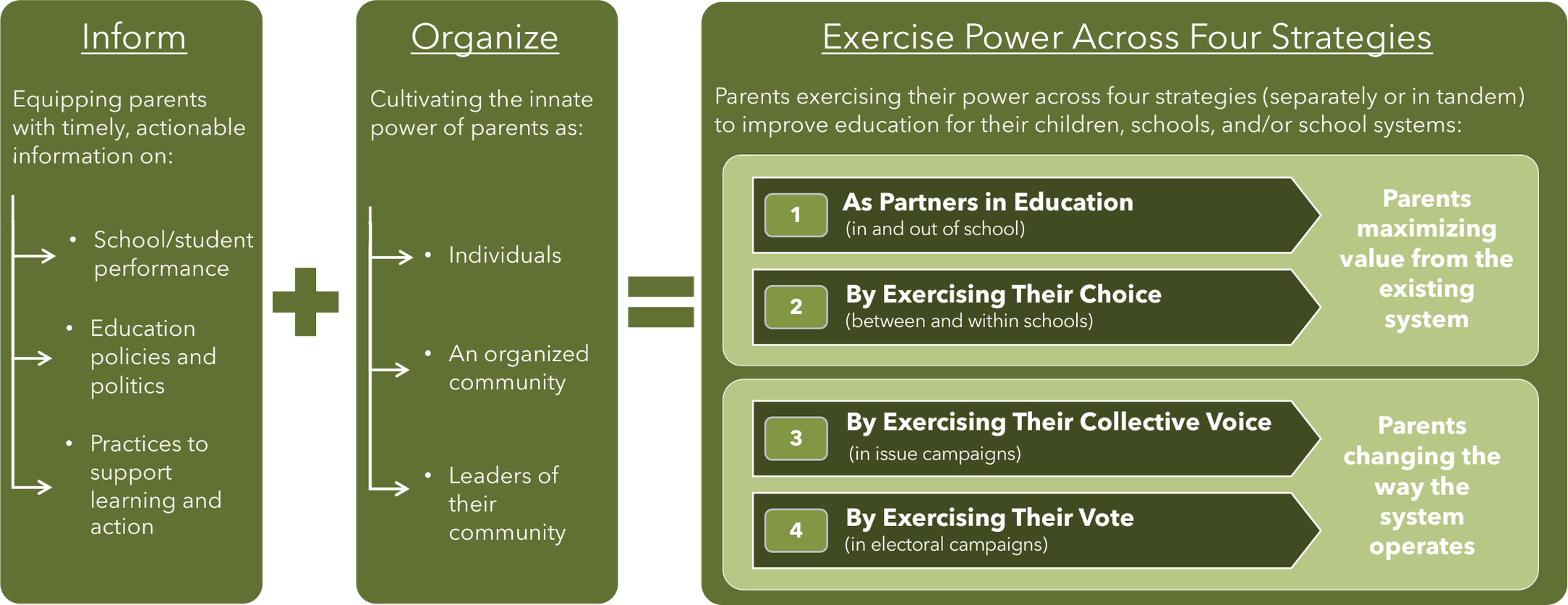
- Strategy 1 – Parents as Partners: Parents exercising their power as co-educators of their children, either in collaboration with schools or through non-school resources.
- Strategy 2 – Exercising their Choice: Parents exercising their power to (a) choose the school that they believe is the best fit for their children’s needs (within whatever constraints around choice exist in their community), and/or (b) make the wide array of choices within a school that reflect the needs of their children.
- Strategy 3 – Exercising their Collective Voice: Parents exercising their power through collective action on an issue campaign to influence those in authority to change policies.
- Strategy 4 – Exercising their Vote: Parents exercising their power through electoral action to influence who holds a position of authority or to directly decide policy through a ballot initiative.
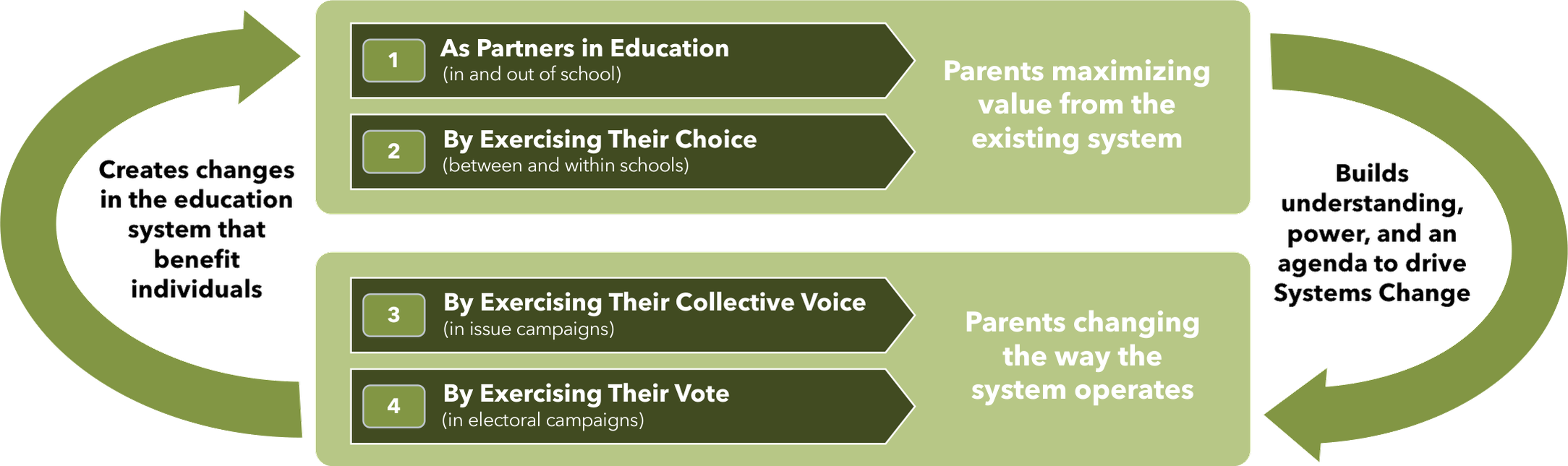
These parent power strategies are mutually reinforcing and can be used in any combination:
Building an Infrastructure of Parent / Community Power
General Community Member: An individual who is consuming value from an organization (e.g., going to its website or social media) or receiving mass outreach from the organization (e.g., mass mailing, mass emailing, advertising) but for whom the organization doesn’t have unique identifying information.
Subscriber/Supporter: An individual who is known to an organization with unique identifying information and who is a consumer of an organization’s resources (in ways that often can be measured). Subscribers are not exclusively supporters; they can include those who oppose an organization’s agenda.
Active Member: Individual Agenda: A parent who is involved in exercising their power through engagement with an organization, with the focus being on meeting their individual needs (versus a larger collective agenda). Supporting these individuals can create value for organizations, and it also strengthens relationships that could then lead toward involvement in a campaign agenda.
Active Member: Collective Agenda: A member involved in exercising their power through a Systemic Impact campaign.
Emerging Leader: A parent beginning to develop a role leading others in collective action.
Formal Leader: A parent who sees themselves and is seen by others as a leader, can plan and execute collective action, and is followed by members of their community.
Formal Authority: A parent who holds a formal role in the system – elected, appointed, or employed – with influence over decisions affecting their community.
Source: Cortez, “Parent Power in Education: Measuring What Matters,” New Profit, April 2019.
Important points to consider
- Each of these roles is different, and each creates distinct value.
- An individual’s progression across these roles need not be linear – they can begin their relationship with an organization in any role. That said, most organizations tend to plan for an initial progression that moves clockwise through these roles.
- An individual may move from one role to another (in any direction) over time depending on their life circumstances and their interest/alignment with an organization’s impact agenda.
- Not every organization’s strategy requires parents to deploy their power in all of these roles! Organizations should customize which roles they prioritize based on a range of factors: their local context; their impact agenda; the strategies they are employing to achieve that agenda; the actions within each strategy; a map of who has what authority in their community and how to exercise power to influence that authority in order to achieve their impact agenda; and/or the ecosystem of partners and other players who share this impact agenda.
For example, organizations focused on supporting parents in partnering or in exercising the power of their choice are going to focus most on Subscribers/Supporters and Active Members acting on their individual agendas.
Organizations focused on strategies around influencing the system through exercising the power of their collective voice (issue campaigns) or exercising the power of their votes (electoral campaigns) will focus heavily on developing an infrastructure of parents as Active Members working on a collective agenda and in Emerging Leader and Formal Leader roles (though the General Community Member and Subscriber/Supporter roles remain important measures of broad reach and engagement with the community, and a pipeline to support parents moving into more involved roles).
Measuring an Infrastructure of Parent/Community Power
Organizations can quantify parent power by measuring the number of parents they have relationships with in each of these roles.
Some organizations do this informally. Others measure the infrastructure of parent power based solely on specific actions, such as phone-banking or public actions (for more on these measures, see the roles below).
Still other organizations explicitly define a set of parent roles, and then invest in developing the number of parents in those roles necessary to succeed in a campaign (and ultimately across multiple campaigns).
An infrastructure of parent power is not built overnight and involves continual engagement with individuals to: (a) build and sustain relationships; (b) understand their needs as parents and their priorities for their children and community; and (c) co-create compelling impact agendas that parents are willing to devote their scarce time and energy to support.
Organizations may also have their own language for how they think about different parent roles. I believe these seven archetypes capture the range of parent roles, but I recognize that each organization may use different internal language/designations.
Further, not every organization uses the same measures to define the same roles. One organization may define a “Subscriber/Supporter” based on a measure that another uses to set the bar for an “Active Member.” There is particular variability across levels of leadership.
Ultimately, each organization needs to decide for itself what roles are included in its infrastructure of parent power and what measures go into the definition of each role. Also, to acknowledge the complexity (and perhaps irony) in measuring infrastructure, it is usually defined by a set of output and outcome measures (see below).
Here are the most common measures tracked to quantify an infrastructure of parent power in each of these seven roles:
(click on a role to see the measures behind it)
Source: Cortez, “Parent Power in Education: Measuring What Matters,” New Profit, April 2019.
General Community Member
An individual who is consuming value from an organization (e.g., going to its website or social media) or receiving mass outreach from the organization (e.g., mass mailing, mass emailing, advertising) but for whom the organization doesn’t have unique identifying information.
This role is quantified mainly through measures of reach (either online reach or mass mailing), although organizations will also track some measures of online engagement.
As a reminder, an organization should “Goldilocks” what it measures. It should capture only measures that help it make better decisions to increase impact (and are practical to collect).
Common measures of reach include:
- Website:
- # of unique visitors to the organization’s website
- # of direct visitors
- # of visitors directed from other websites
- # of unique visitors to the organization’s website
-and/or-
- Social Media:
- # of views on Facebook
- # of views on Twitter
- # of views on YouTube
-and/or-
- # of people sent mass mailings (using third-party mailing lists, and not individuals who have provided their unique identifying information to the organization)
Common measures of engagement include:
- Website:
- Average time spent on website (overall)
- # who spend time on specific content (and average time spent)
- # who spend X minimum time on specific content such as videos
- # who download content (if allowed without first providing unique identifying information)
-and/or-
- Social Media:
- Facebook
- # of likes (overall and by key posts)
- # of shares (overall and by key posts)
- # of followers
- # of comments
- Twitter
- # of likes (overall and by key tweets)
- # of shares (overall and by key tweets)
- # of followers
- # of comments
- YouTube
- # of likes (overall and by key content)
- # of shares (overall and by key content)
- # of followers
- # of comments
- Facebook
Subscriber/Supporter
An individual who has made a deliberate choice to give an organization unique identifying information – online or by signing up at real-world events – so that they can have ongoing engagement with that organization and its content. Not all Subscribers are necessarily Supporters. Some Subscribers may be opposed to the organization’s agenda, but may want to consume the content it provides.
Most organizations define Subscribers/Supporters only based on measures of reach and engagement. However, several organizations also define Subscribers/Supporters based on online actions that individuals take and that can be tracked (though many organizations consider these people to be Active Members).
As a reminder, an organization should “Goldilocks” what it measures. It should capture only measures that help it make better decisions to increase impact (and are practical to collect).
Common measures of reach include:
- # who have given the organization their email, mailing address, and other unique information through any channel (online or real-world)
- # who sign up for website content (if the organization asks for sign-up)
- # who sign up at real-world events
- # who receive email from the organization (specifically, individuals who have given it unique identifying information)
- # who receive mail from the organization (specifically, individuals who have given it unique identifying information)
Common measures of engagement by individuals who have provided unique identifying information to the organization:
- Online engagement:
- # who spend time on website (and average time spent)
- # who spend time on specific content (and average time spent)
- # who spend X minimum time on specific content such as videos
- # who download content
- # who request mailed content
- # who open emails
- # who click through email to content, and measures of time spent on content
- Real-world engagement
- # who attend an event or workshop
- # who attend an event or workshop and sign up to become a new Subscriber/Supporter
Common measures of action: Several organizations define a Subscriber/Supporter not just on their reach and engagement, but on whether they take actions online (for other organizations, these are measures to define an Active Member). Common measures include:
- Online action
- # who have signed a petition
- # who have engaged with an authority figure by sending a letter online
- # who have engaged with an authority figure by sending a report, article, or analysis
- # who have completed a survey
- # who have posted their story online
Active Member: Individual Agenda
A parent who is actively involved in exercising their power through engagement with an organization, with the focus being on meeting the individual, specific needs of their children (vs. a larger collective agenda).
This role is commonly measured through a combination of both engagement and action.
As a reminder, an organization should “Goldilocks” what it measures. It should capture only measures that help it make better decisions to increase impact (and are practical to collect).
Common measures of engagement: # of general touchpoints with a parent, or segmentation by specific activities, such as:
- # who attend events, workshops, or trainings
- # who attend a single event/workshop/training, or
- # who attend a specific target dosage of events/workshops/trainings
-and/or-
- # who participate in a certain number of 1-on-1 meetings (with an organizer, navigator, or teacher)
- # who attend a single meeting, or
- # who attend a specific target dosage of meetings over a specific period of time
Common measures of action: Note, these actions will vary based on whether parents are exercising their power as partners in education or exercising the power of their choice.
Choice measures here are focused on choices between schools (i.e., which school to try to attend), but it is also possible to consider measures of choices parents make within a school (such as course selection, or advocating for the specific needs of a child), though these are not listed here.
- On Partnership
- # who attend parent/teacher conferences, and/or
- # who engage in home visits with teachers, and/or
- # who spend X hours per week helping with homework
- On Choice:
- # who take an action to support their child in school choice
- # who start and complete a lottery (on or offline), and/or
- # who apply to more than one school, and/or
- # who make a deliberate change in school with characteristics more aligned to their child’s educational needs and priorities (as they assess it)
- # who take an action to support their child in school choice
Active Member: Collective Agenda
These are parents who are actively involved in exercising their power through engagement with an organization on a community-level collective agenda, usually related to exercising the power of their collective voice in an issue campaign or exercising the power of their vote in an electoral campaign.
There is a wide range of actions an organization and its parents may take as part of these types of campaigns.
As a rule, most organizations use demonstrated involvement in recent campaigns as a starting point to measure an individual’s ability and willingness to assume such a role in future campaigns.
As a reminder, an organization should “Goldilocks” what it measures. It should capture only measures that help it make better decisions to increase impact (and are practical to collect).
Common measures include:
- Training: # who have completed a training or workshop: This can be a general training or workshop, or specific to building the skills to participate in a particular action (such as taking part in a research meeting, being trained in how to tell their story in a video, phone-banking, or canvassing)
-and/or-
- Involvement – overall: # who have been involved in X number of actions within Y time period (with the number of actions and the time period involved varying). For example:
- One organization measures this as involvement in 2 or more actions within the last 90 days
- Another measures this as involvement in 4 or more actions within the last 12 months
-and/or-
- Involvement – specific actions: # who have been involved in a specific mix of actions within a time period. Some organizations may find value in knowing how many of their members are participating in specific types of action so that they can plan and execute campaigns accordingly. And some define Active Members based on their participation in a specific set of these actions.
Please note, involvement in some of these actions may be used by organizations to define Active Members, while others may use them in their definition of an Emerging Leader or Formal Leader (particularly those actions involving communicating as an individual publicly or to those in authority).
Common specific measures of real-world action include:
- # who have signed a petition
- # who have been involved in a public action
- # who have been involved in a candidate forum
- # who have been involved in a house meeting
- # who have been involved in a research meeting
- # who have been involved in phone-banking
- # who have been involved in canvassing
- # who have been involved in lobbying
- # who have been involved in get-out-the-vote
Common specific measures of communications-related actions (online and real-world) include:
- # who have signed a petition
- # who have completed a survey
- # who have engaged with an authority figure by sending a letter online
- # who have engaged with an authority figure by sending a report, article, or analysis
- # who have posted their story online
- # who have created a video testimonial
- # who have given public testimony
Emerging Leader and Formal Leader
Organizations think about Emerging Leaders and Formal Leaders on a continuum, though most start by measuring an individual’s completion of a formal leadership training. As a rule, most organizations use demonstrated experience in leading actions on recent campaigns as a starting point to measure an individual’s ability and willingness to assume such a role in future campaigns.
Some organizations measure leadership roles based on the overall number of actions of any type an individual has taken, while others measure leadership based on a specific set or combination of actions. The former is simpler, while the latter gives an organization a sense of which individuals spike in their leadership of particular actions.
Some organizations have different expectations about which type of actions an Emerging Leader vs. a Formal Leader should be involved in. For example, some may designate an Emerging Leader as someone who leads a house meeting, and a Formal Leader as someone who leads a large public action (which requires more effort to organize and lead).
Others have the same expectations in terms of types of actions but different expectations about the target level of action. For example, an Emerging Leader is someone who is involved in 4 actions in a certain time period and a Formal Leader is involved in 8 actions in the same time period.
As a reminder, an organization should “Goldilocks” what it measures. It should capture only measures that help it make better decisions to increase impact (and are practical to collect).
Common measures of Emerging Leadership and Formal Leadership include:
- Training: # who have completed a leadership training (usually a multi-session training or formal fellowship). This may include completing deliverables such as a story of self and an individual’s mapping of their network capital. This may include not only leadership development, but training on education policy and politics, campaign planning, school budgeting, etc. This may also include pre- and post-testing on knowledge and self-assessment of change in attitudes about power (theirs and others).
- Involvement: # who were involved in X number of actions within Y time period. This may be a general number of actions or a specific mix of actions. Organizations also tend to measure, even for an Emerging Leader, involvement in actions that others lead as this demonstrates commitment and development of knowledge and expertise about executing actions. For a list of these actions, please see Active Member: Collective Agenda.
- Leadership – overall: # who have organized and led one or more actions in a specific time period. Some organizations measure actions in aggregate rather than break them out by type. Others measure both the total number of actions and by specific type (see below).
- Leadership – specific actions: # who have organized and led one or more specific mix of actions in a specific time period. Please note, not every organization assumes an Emerging Leader and Formal Leader are expected to be able to organize and lead the same types of actions. Common measures for both Emerging Leaders and Formal Leaders (but with likely different targets) include:
- # who have organized and led one or more research meetings
- # who have organized and led one or more public actions (or been part of a team of leaders doing so)
- # who have organized and led one or more lobbying actions
- # who have organized and led one or more house meetings
- # who have organized and led one or more phone-banking actions
- # who have organized and led one or more canvassing actions
- # who have organized and led one or more 1:1 meetings with other parents and community members
- Leadership – specific communication actions: # who have been trained in and can execute specific communication actions. These tend to be more expected of Formal Leaders than Emerging Leaders. Common measures include:
- # who have led one or more general (e.g., any of the below) communication actions
- # who have given interviews to the media
- # who have led press conferences with the media
- # who have written letters to the editor
- # who have given public testimony
Three communication actions (below) tend to stand out as measures specific to individuals defined as Formal Leaders. Note, for all of these, organizations provide training and support to build parent capacity to lead on these actions:
- # who have written and published original content
- # who have written public policy platforms
- # who have responded to external content (e.g., newspaper articles, third-party reports, blogs, etc.) to support an organization and its campaign
- Leadership – Turnout: # who have demonstrated the ability to get X members of their community to attend an action. Note – this is a less common measure but important to some organizations, and also one where the target level can be greater for a Formal Leader vs. an Emerging Leader.
Emerging Leader and Formal Leader
Organizations think about Emerging Leaders and Formal Leaders on a continuum, though most start by measuring an individual’s completion of a formal leadership training. As a rule, most organizations use demonstrated experience in leading actions on recent campaigns as a starting point to measure an individual’s ability and willingness to assume such a role in future campaigns.
Some organizations measure leadership roles based on the overall number of actions of any type an individual has taken, while others measure leadership based on a specific set or combination of actions. The former is simpler, while the latter gives an organization a sense of which individuals spike in their leadership of particular actions.
Some organizations have different expectations about which type of actions an Emerging Leader vs. a Formal Leader should be involved in. For example, some may designate an Emerging Leader as someone who leads a house meeting, and a Formal Leader as someone who leads a large public action (which requires more effort to organize and lead).
Others have the same expectations in terms of types of actions but different expectations about the target level of action. For example, an Emerging Leader is someone who is involved in 4 actions in a certain time period and a Formal Leader is involved in 8 actions in the same time period.
As a reminder, an organization should “Goldilocks” what it measures. It should capture only measures that help it make better decisions to increase impact (and are practical to collect).
Common measures of Emerging Leadership and Formal Leadership include:
- Training: # who have completed a leadership training (usually a multi-session training or formal fellowship). This may include completing deliverables such as a story of self and an individual’s mapping of their network capital. This may include not only leadership development, but training on education policy and politics, campaign planning, school budgeting, etc. This may also include pre- and post-testing on knowledge and self-assessment of change in attitudes about power (theirs and others).
- Involvement: # who were involved in X number of actions within Y time period. This may be a general number of actions or a specific mix of actions. Organizations also tend to measure, even for an Emerging Leader, involvement in actions that others lead as this demonstrates commitment and development of knowledge and expertise about executing actions. For a list of these actions, please see Active Member: Collective Agenda.
- Leadership – overall: # who have organized and led one or more actions in a specific time period. Some organizations measure actions in aggregate rather than break them out by type. Others measure both the total number of actions and by specific type (see below).
- Leadership – specific actions: # who have organized and led one or more specific mix of actions in a specific time period. Please note, not every organization assumes an Emerging Leader and Formal Leader are expected to be able to organize and lead the same types of actions. Common measures for both Emerging Leaders and Formal Leaders (but with likely different targets) include:
- # who have organized and led one or more research meetings
- # who have organized and led one or more public actions (or been part of a team of leaders doing so)
- # who have organized and led one or more lobbying actions
- # who have organized and led one or more house meetings
- # who have organized and led one or more phone-banking actions
- # who have organized and led one or more canvassing actions
- # who have organized and led one or more 1:1 meetings with other parents and community members
- Leadership – specific communication actions: # who have been trained in and can execute specific communication actions. These tend to be more expected of Formal Leaders than Emerging Leaders. Common measures include:
- # who have led one or more general (e.g., any of the below) communication actions
- # who have given interviews to the media
- # who have led press conferences with the media
- # who have written letters to the editor
- # who have given public testimony
Three communication actions (below) tend to stand out as measures specific to individuals defined as Formal Leaders. Note, for all of these, organizations provide training and support to build parent capacity to lead on these actions:
- # who have written and published original content
- # who have written public policy platforms
- # who have responded to external content (e.g., newspaper articles, third-party reports, blogs, etc.) to support an organization and its campaign
- Leadership – Turnout: # who have demonstrated the ability to get X members of their community to attend an action. Note – this is a less common measure but important to some organizations, and also one where the target level can be greater for a Formal Leader vs. an Emerging Leader.
Formal Authority
A parent who holds a formal role in the system – elected, appointed, or employed – to have influence on decisions affecting their community.
As a reminder, an organization should “Goldilocks” what it measures. It should capture only measures that help it make better decisions to increase impact (and are practical to collect).
Common measures include:
- # who have demonstrated ability as a Formal Leader with an organization (see measures of defining formal leadership)
-and-
- # who have completed a specific leadership training or fellowship that prepares them to pursue a position of Formal Authority
-and-
- # who pursue and achieve positions of Formal Authority
- # who run for and win an elected position
-and/or-
- # who are nominated for, selected for, and accept an appointed position – including on non-elected boards
-and/or-
- # who become formally employed in a position of authority
- In the school system or municipal or state government, and/or
- In a nonprofit in education, including the organization doing the measuring (Note, some organizations specifically measure those parents who take on a formal, employed role as a professional in organizing)
Publications on Parent Power
- Systems Change and Parent Power: Systems Change Is Education Philanthropy’s Only Exit Strategy; and Parent Power Is What Will Change Systems. New Profit, December 2020.
- Picket Signs & Shovels: Lessons on Parent Power and Systems Change from Umm Al-Fahm, Israel. New Profit, April 2021.
- Building Parent Power: Insights From the Field. Bellwether, June 2023, including a set of parent power case studies: FaithActs for Education, GO Public Schools, Innovate Public Schools, Kids First Chicago, and Parents Amplifying Voices in Education.
- Amid the Chaos of Coronavirus, Parent Power and Parent Organizing Have Never Been More Important. It’s Time for Education Funders to Show Them the Money. The 74, April 2020.
- Parent Power in Education: Measuring What Matters. A set of web-based resources representing the work of a community of practice of 18 parent power organizations working together over the course of a year.
- Web-based set of tools and resources: www.parentpowerined.org. New Profit, April 2019.
- “In the Room Where It Happens” – Parents Assuming Formal Authority to Drive Change. The 74, May 2019.
- An Infrastructure of Parent Power – The Magnificent 7. The 74, May 2019.
- If You Believe in Parent Power, What Are Your Values? The 74, April 2019.
- Parent Power Is Key to Changing Education Systems, and Measurement Is Key to Scaling Parent Power. The 74, April 2019.
- Web-based set of tools and resources: www.parentpowerined.org. New Profit, April 2019.
- Case Study: An “Education Return on Investment” in Funding Parent Empowerment. The 74, December 2017.
- Key Lessons From a Blue Ribbon School in Los Angeles: 3 Ways to Build an Effective and Enduring Education Agenda. The 74, October 2017.
- Notes From the Field: If You Want Great Schools, First Work With Parents to Create Actionable Demand. The 74, May 2017.